
The MCP server
MCP servers: Odoo 20's and ours do different jobs
Odoo 20 ships an MCP server. Senedoo has run one for two years. Same acronym, different use — and the confusion would cost dearly to anyone plugging an AI into production without knowing it.
What is an MCP?
MCP, for Model Context Protocol, is an open standard describing how an artificial intelligence uses a piece of software. Rather than letting the AI write straight into your database, it is handed a list of declared tools: "search invoices", "read a model's fields", "create a customer". Each tool has its parameters and its rights. The AI picks a tool and calls it; it never reaches the database any other way. That is what makes professional use conceivable: you know what the AI can do, and you can forbid it.
The MCP server shipped by Odoo
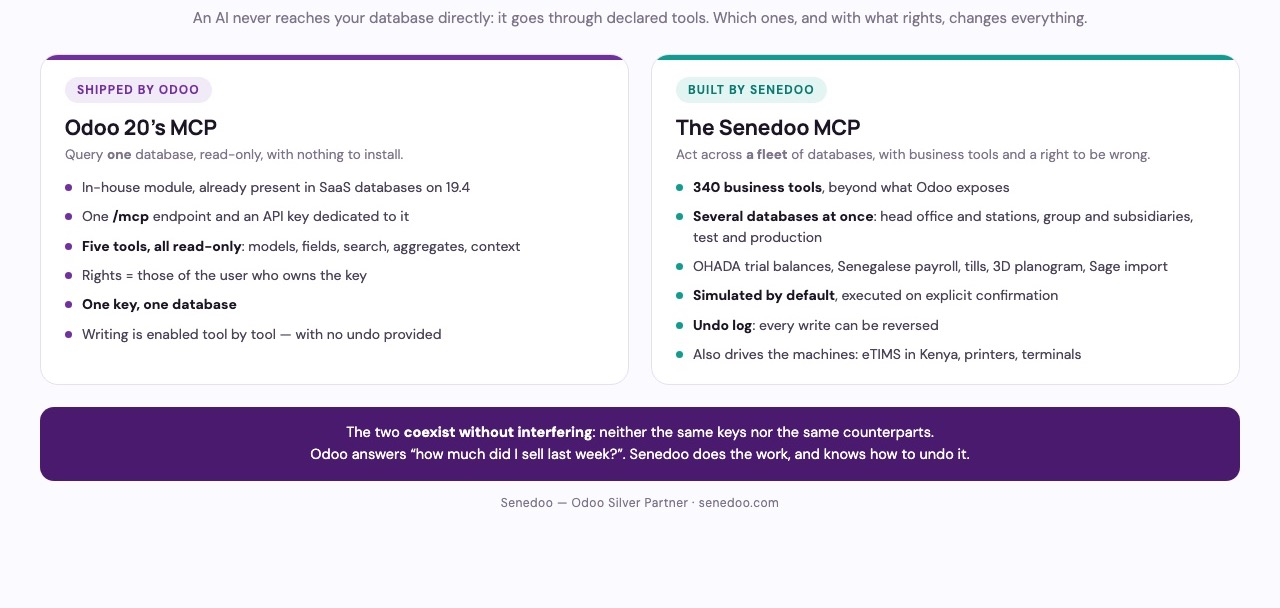
It comes with version 20, as an in-house module — and, we checked, it is already present in SaaS databases on 19.4. You query it at /mcp on your database, with an API key created in your preferences and dedicated to that use. By default it exposes five tools, all read-only: list models, read their fields, search records, group and aggregate, retrieve an initial context. The rights applied are those of the user who owns the key. Others — create, update, read an attachment — can be exposed by ticking them one by one in the server actions.
What it brings, with nothing to install: an assistant such as Claude or ChatGPT answers "how much did I sell last week?" by reading your data, under your rights, in your database.
Its limits, which are not flaws: one key, one database; writing is not exposed by default and, once exposed, nothing is provided to undo it; and it only knows what Odoo contains.
The Senedoo MCP server
Ours was born before the protocol entered Odoo, and for another need: letting our consultants and our clients work across a fleet of databases, with business tools Odoo does not provide.
- Several databases at once: a central office and its stations, a group and its subsidiaries, a test database and its production — compare, synchronise, consolidate in a single view.
- Business tools: six-column trial balance and SYSCOHADA income statement, VAT, BRS, payslips under Senegalese agreements, 3D planogram, shelf labels, till monitoring, Sage imports reconciled to the franc.
- Writing, but reversible: every operation is simulated first, runs only on explicit confirmation, and stays logged so it can be undone. That is the condition for letting an AI touch a production database.
- The machines around Odoo: eTIMS fiscal gateways in Kenya, receipt printers, payment terminals — driven by the same tools.
Which one for what?
Odoo's MCP is the right choice to query one database read-only, with nothing to install, from the assistant you already use. The Senedoo MCP is for acting: across several databases, with business tools, and with a right to be wrong. The two coexist without interfering: they use neither the same keys nor the same counterparts.
Where to start, carefully
- Create a dedicated user with strictly necessary rights, and an API key reserved for that use.
- Stay read-only long enough to see what your teams actually do with it.
- Only open writing with someone able to undo — otherwise a badly worded instruction becomes an accounting entry.
We open the Senedoo MCP server to clients under contract, for their trained teams. See our technology or talk to us about it.