
Import logistics costs
Logistics costs: what an imported material really costs, and its average cost in Odoo.
Vendor price, freight and insurance, customs duties and taxes, forwarder, port, truck: the cost that enters stock is the landed cost at the plant. Odoo splits it over the receipt and recomputes the item's average cost (AVCO).
From a 400 F vendor price to a landed cost of 508.88 F per kilo.
Example: 20 tonnes of soybean meal bought at 400 F per kilo, by sea to Dakar, then by truck to the plant. Customs duty taken at 5% for the example.
Import VAT (18%) is not part of the cost. Computed on the CIF value plus duties and taxes, 1,705,968 F here, it is recoverable for a VAT-registered company: it goes to deductible VAT, not into the stock value.
| Vendor price20,000 kg × 400 F | 8,000,000 F |
| Sea freight | 750,000 F |
| Insurance | 50,000 F |
| CIF valuecost, insurance, freight | 8,800,000 F |
| Customs duty (DD)5% of the CIF value | 440,000 F |
| Statistical fee (RS)1% | 88,000 F |
| ECOWAS levy (PC)0.5% | 44,000 F |
| WAEMU levy (PCS)0.8% | 70,400 F |
| COSEC0.4%, sea freight | 35,200 F |
| Forwarder and port chargesfees, handling, storage | 450,000 F |
| Transport to the plant | 250,000 F |
| Landed cost at the plant508.88 F per kilo, +27.2% | 10,177,600 F |
What customs levies on imports into Senegal.
Usual rates; always check those on your customs assessment, which depend on the tariff line and the origin of the goods.
0, 5, 10, 20 or 35% of the CIF value, depending on the ECOWAS common external tariff category.
1% of the CIF value.
0.5% of the CIF value.
0.8% of the CIF value.
0.4%, only for imports by sea.
18% of the CIF value plus duties and taxes; recoverable, not a stock cost.
Depending on the product, excise duties and a cyclical import tax on some food products may be added. Source of the rates: DGDDI, “10 questions export Sénégal” sheet.
The bills that arrive after the goods.
Clearance, declaration, file handling: often a separate bill.
Handling, storage: they rise with every day spent at the port.
From the port to the plant, by truck: a carrier bill.
These bills arrive days, sometimes weeks after the receipt.
Landed costs.
Inventory › Settings › Valuation: enable Landed Costs, with a default journal.
Service product, “Is a Landed Cost” box, default split method: freight, insurance, customs, forwarder, transport.
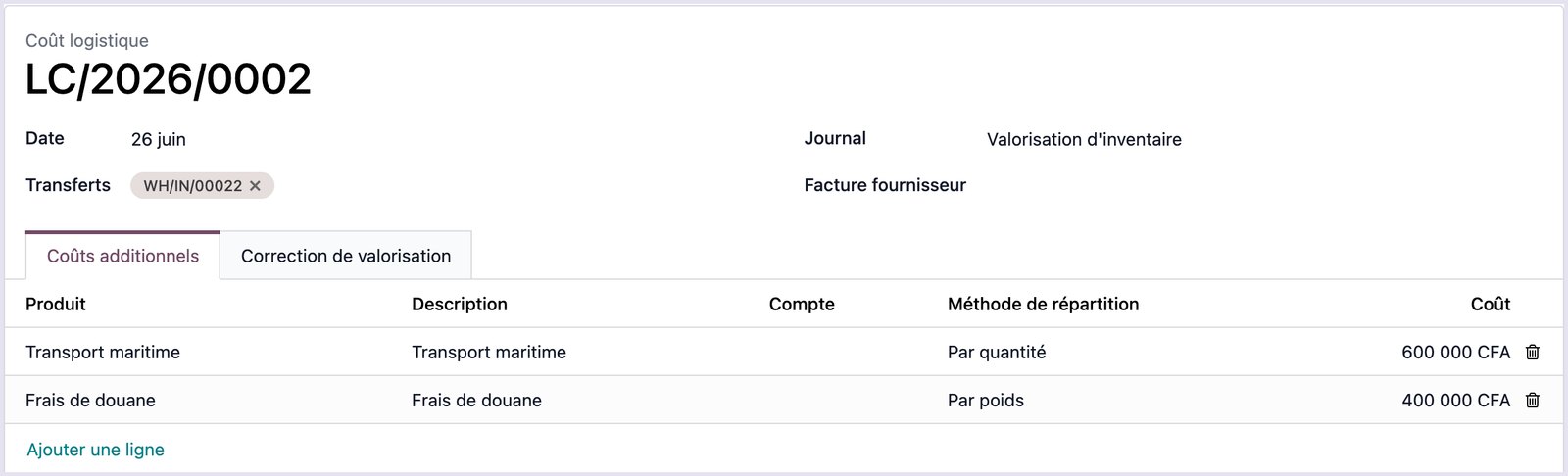
On the forwarder's or carrier's bill, the cost line creates the landed cost record (Create Landed Costs).
Pick the validated receipts concerned: only validated transfers can be selected.
Equal, by quantity, by current cost, by weight or by volume (Split Method): see the split methods below.
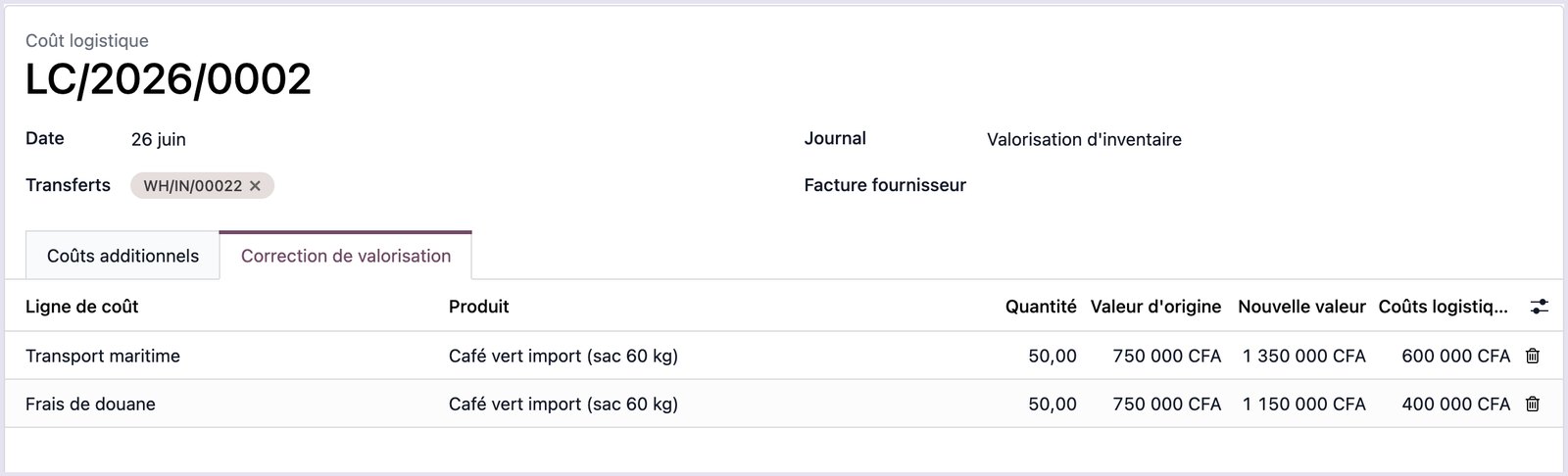
Compute: original value + cost = new value, line by line (Valuation Adjustments); then Validate.
Items received must be in a category using average cost (AVCO) or FIFO.
A validated record cannot be cancelled: correct it with negative landed costs.
One container, several items: who pays which share of the freight?
A landed cost covers the whole receipt. Odoo shares it between the items received according to a split method, chosen line by line on the landed cost record. There are five methods; they give very different costs.
The amount divided by the number of lines received, whatever the quantity of each line: 1 bag or 300 bags, same share.
In proportion to the quantities received, each in its item's stock unit.
In proportion to the value of each line at receipt: quantity × purchase price.
In proportion to the weight received: the Weight field of the product form × the quantity.
In proportion to the volume received: the Volume field of the product form × the quantity.
900,000 F of freight, three items, five results.
Example. The 2,000 empty bags weigh only 200 kg: by weight they carry 8,911 F of freight; by quantity, 720,000 F, 80% of the container. The premix, light and expensive, pays 222,772 F by weight and 475,352 F by value.
The cost to split
Item 1
Item 2
Item 3
Weight and volume: the Weight and Volume fields of the product form in Odoo, for one stock unit. Enter 0 to see what Odoo does when they are missing.
| Method | Soybean meal, 50 kg bag | Premix, 25 kg pail | Empty woven bags |
|---|---|---|---|
| EqualEqual | 300,000 F1,000 F per unit | 300,000 F1,500 F per unit | 300,000 F150 F per unit |
| By quantityBy Quantity | 108,000 F360 F per unit | 72,000 F360 F per unit | 720,000 F360 F per unit |
| By current costBy Current Cost | 380,282 F1,268 F per unit | 475,352 F2,377 F per unit | 44,366 F22.18 F per unit |
| By weightBy Weight | 668,317 F2,228 F per unit | 222,772 F1,114 F per unit | 8,911 F4.46 F per unit |
| By volumeBy Volume | 635,294 F2,118 F per unit | 158,824 F794 F per unit | 105,882 F52.94 F per unit |
The rule we apply with our clients.
Our recommendation, to adapt to how each provider bills. The principle: split a cost the way it was calculated.
| Cost | Method | Why |
|---|---|---|
| Sea freight, full container | By weight or by volume | By weight if the container fills up by weight (heavy bulk), by volume if it fills up by space (light, bulky goods). |
| Groupage freight | By volume | The carrier bills per cubic metre or per tonne: the method follows the space taken. |
| Insurance | By current cost | The premium is a percentage of the insured value. |
| Customs duties and taxes | By current cost | They are computed on the value, provided all items have the same customs duty rate. |
| Handling, truck | By weight | You pay per tonne handled or carried. |
| Forwarder fees | By current cost or equal | By value if the fee follows the declared value, equal for a flat fee per file. |
| Test, certificate per item | Equal | The same amount per line received, whatever the quantity. |
| Identical items, same unit | By quantity | The only case where counting units makes sense. |
What Odoo does, checked in its code.
Read in the Landed Costs module (stock_landed_costs) of Odoo 19: the calculation flags none of these cases.
If no item received has a weight, the by-weight method splits equally, without warning. Same for volume.
If the others have one, it gets nothing by weight: its cost is understated, the others inflated.
“By quantity” adds up kilos, bags and pieces as if they were the same thing.
“By current cost” applies the same rate to all. With different rates, measure the gap; it is corrected with one landed cost record per receipt when the items arrive on separate receipts.
It is set on the landed cost product (Default Split Method); without it, a new line starts as equal.
How Odoo recomputes the item's cost.
Average cost = (quantity in stock × current average cost + quantity received × purchase cost) ÷ total quantity. The purchase cost includes landed costs. A stock issue does not change the average cost.
| Before the receipt30,000 kg × 480.00 F | 14,400,000 F |
| Receipt, landed cost20,000 kg × 508.88 F | 10,177,600 F |
| After the receipt50,000 kg | 24,577,600 F |
| New average cost24,577,600 F ÷ 50,000 kg | 491.55 F |
The settings that matter.
At receipt, on the forwarder's estimate, before the material goes to the shop floor: the next manufacturing orders take it into account.
By weight or by volume for freight, by current cost for insurance and customs, and weights and volumes filled in on every product form.
Import VAT is not a landed cost: it stays in deductible VAT.
Freight billed in euros or dollars: converted at the day's rate like any foreign-currency purchase.
Cost prices that count everything.
We create your landed cost products, their accounts and split methods, and take over your latest imports.