
Point of sale
Tills that take mobile money, and a store in 3D.
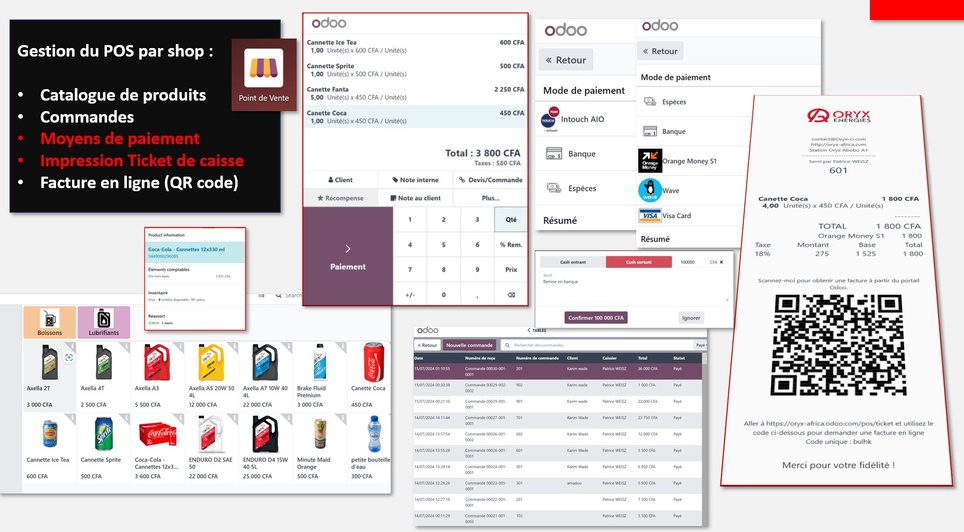
We equip perfumeries, nutrition shops, service station shops, restaurants. The Odoo till must be invisible to the customer and precise for management: product variants, loyalty, cycle counts with a barcode scanner, and Wave and Orange Money in Senegal, M-Pesa in Kenya, reconciled automatically.
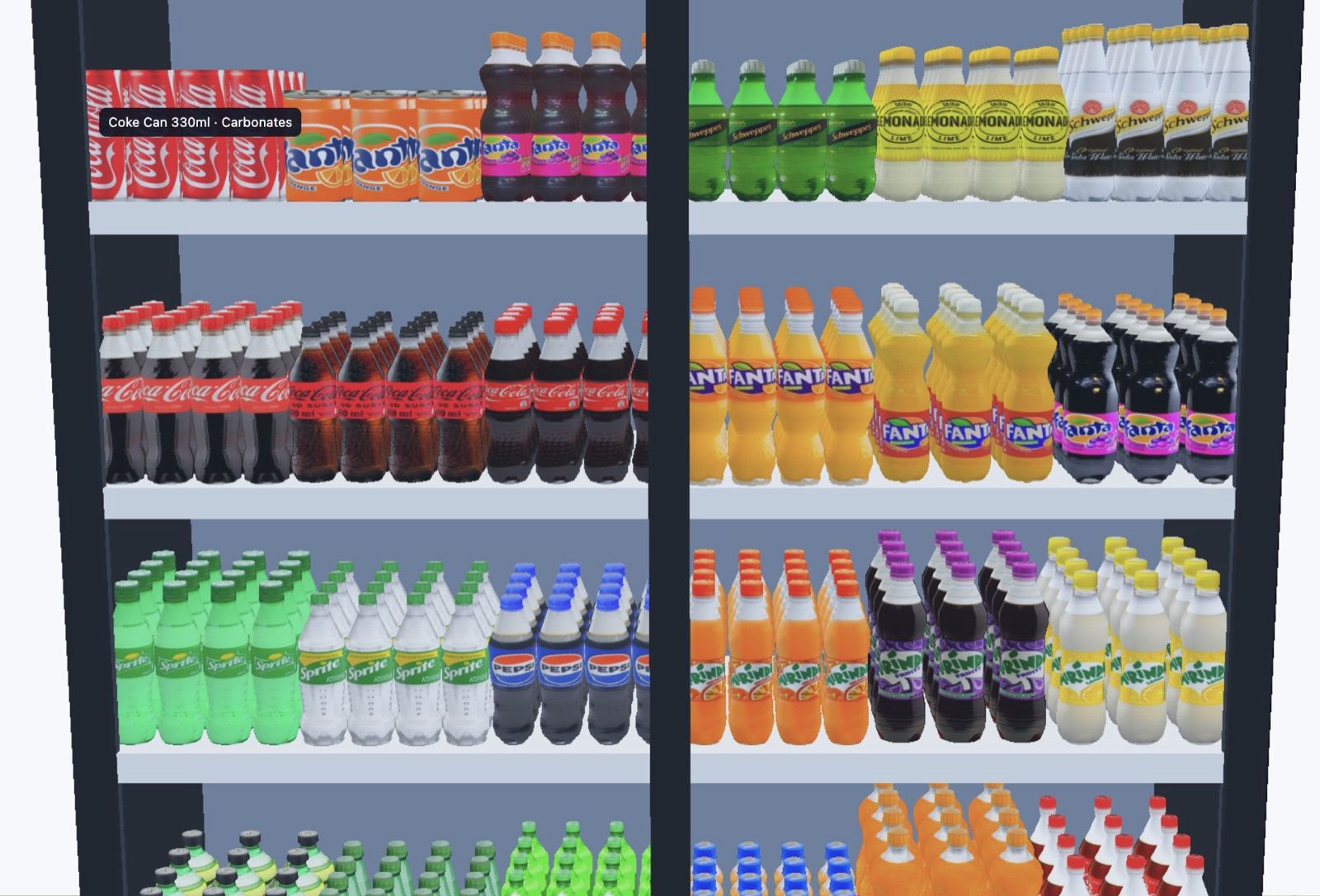
For networks, we built something nobody else has: the store in 3D. Every shelf is modelled with the real photos and pack sizes of the products; it fills at receipts and empties at Odoo sales. The manager sees the empty shelf before the customer does. Simulated shoppers with real purchase profiles walk the store and reveal gaps with their reason.
Around it: shelf price tags printed from Odoo in ten sheet formats, suggested replenishment computed on sales, and till monitoring that catches a forgotten session or a stuck receipt before opening.
For multi-site networks, our "virtual warehouse" circuit: each station orders from the central purchasing company, which splits into drop-shipments per supplier; each station receives under its own tax PIN.
Walk into the store
A station shop rebuilt in 3D, playable right here: orbit the camera with the mouse, switch views (store, top, stockroom), run the demo to watch shelves empty and the stockroom refill them, follow a shopper. It is the very engine running for Rubis in Nairobi — with a small demo layout, ten products, and no client data.
On mobile: drag to orbit, pinch to zoom. Open full screen for comfort.
eTIMS fiscalisation, in production
In Kenya every receipt must be signed by a KRA-approved fiscal device. We built the bridge between Odoo and Tremol control units: receipt signed, KRA number printed, tariff classification carried by the product, queue resumed after an outage. Signing log available, receipts reprintable.
Our Kenyan tills accept M-Pesa natively and reconcile it without chasing SMS. They are monitored from Dakar and Nairobi, and documented in English.