
Technology and AI
Real-time interfaces with Odoo.
Odoo is excellent at capturing and keeping data. It is less good at showing it the way a managing director, a Senegalese accountant or a shop manager needs it. Rather than developing inside Odoo — which costs at every upgrade — we built a technology that works alongside Odoo, live, without copying your data.
It opens inside Odoo. Our OHADA balances, your dashboard, the stock location view, the Excel exports appear in Odoo's menus, with your access rights, without a second login.
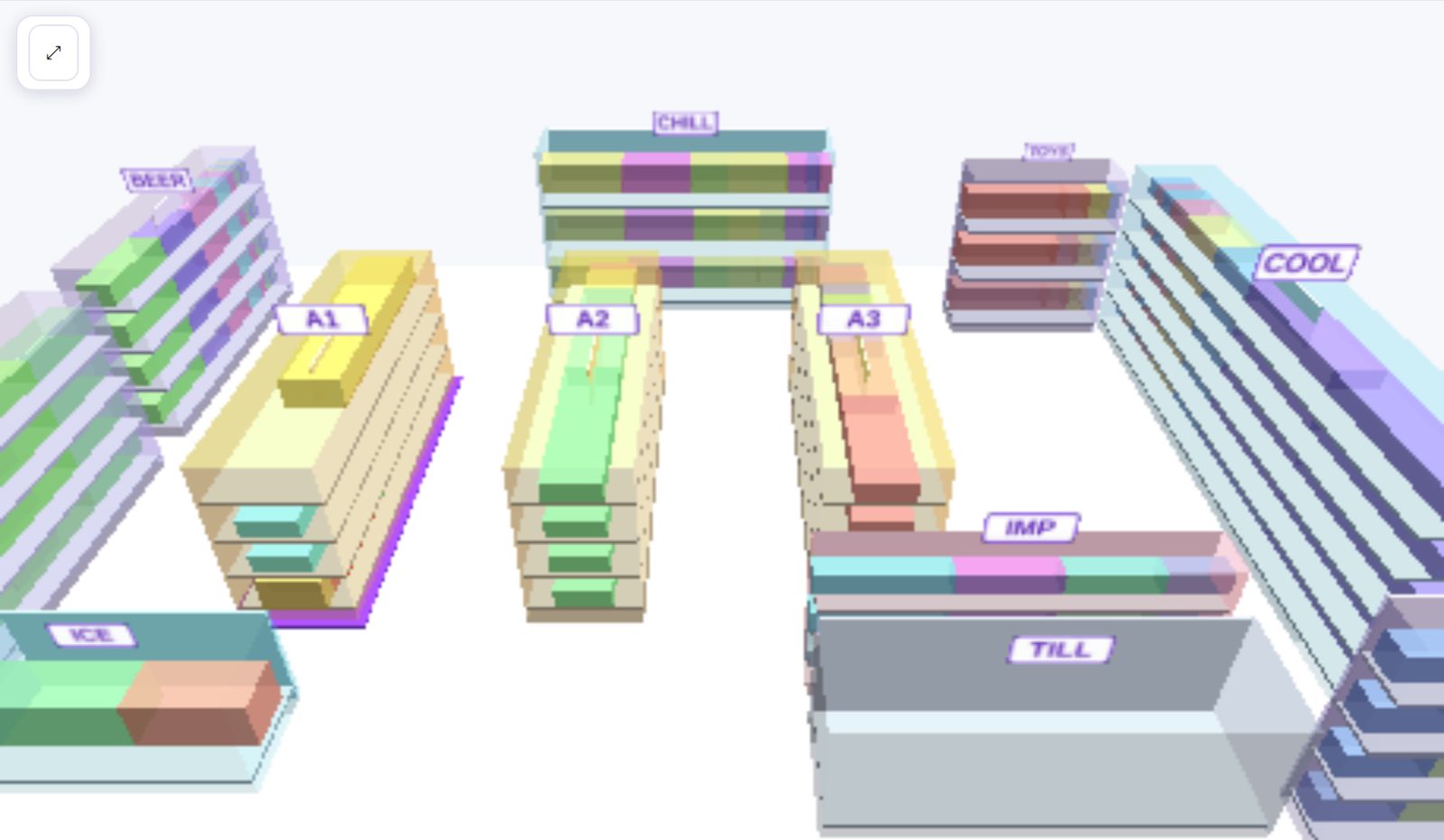
It reads Odoo the moment you look. No data warehouse refreshed overnight: the balance you open at 10:04 contains the entry posted at 10:03. The 3D planogram fills at receipt and empties at sale.
It listens to Odoo. A validated invoice, a closed till session, a confirmed order: Odoo notifies our server, which updates the dashboard, flags the forgotten session, or triggers a supplier order.
It talks to machines. Tremol fiscal devices in Kenya, receipt printers, M-Pesa terminals: our gateways run next to the till and keep a queue, so an internet outage never blocks a sale.
It sees several databases at once. Five stations, five Odoo databases, one dashboard; one configuration compared with another; a central purchasing company that splits its orders across its stations' databases.
And it stays reversible: every write is logged and can be undone, access to your databases is encrypted and specific to each client, and you receive the rebuild sheet of your configuration.
AI drives your databases
An MCP server connects Claude or ChatGPT to your Odoo databases: reading, logged and reversible writing, under your access rights.
AI and the MCP server →Clusters of SaaS databases
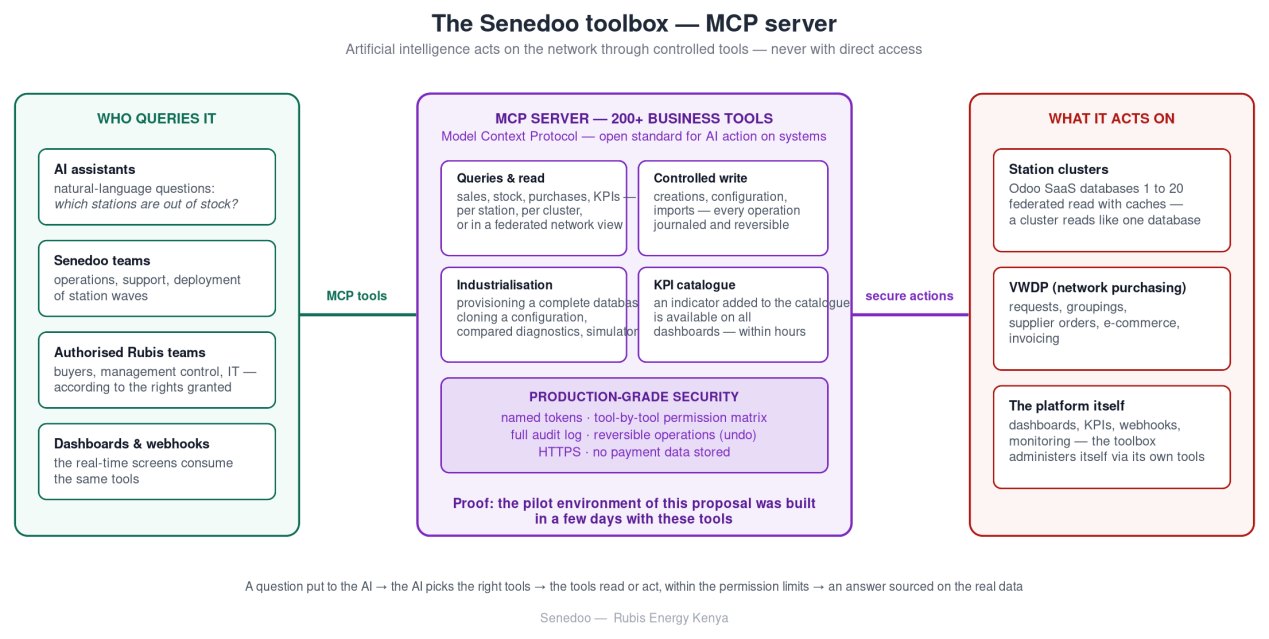
One database per cluster of about twenty sites, master data propagated, a federated view: an incident stays local, you grow by adding clusters.
SaaS clusters →The Senedoo ToolBox
Client portal, add-ons installable in Odoo, orchestrator: our technology alongside Odoo, live, without copying your data.
The ToolBox →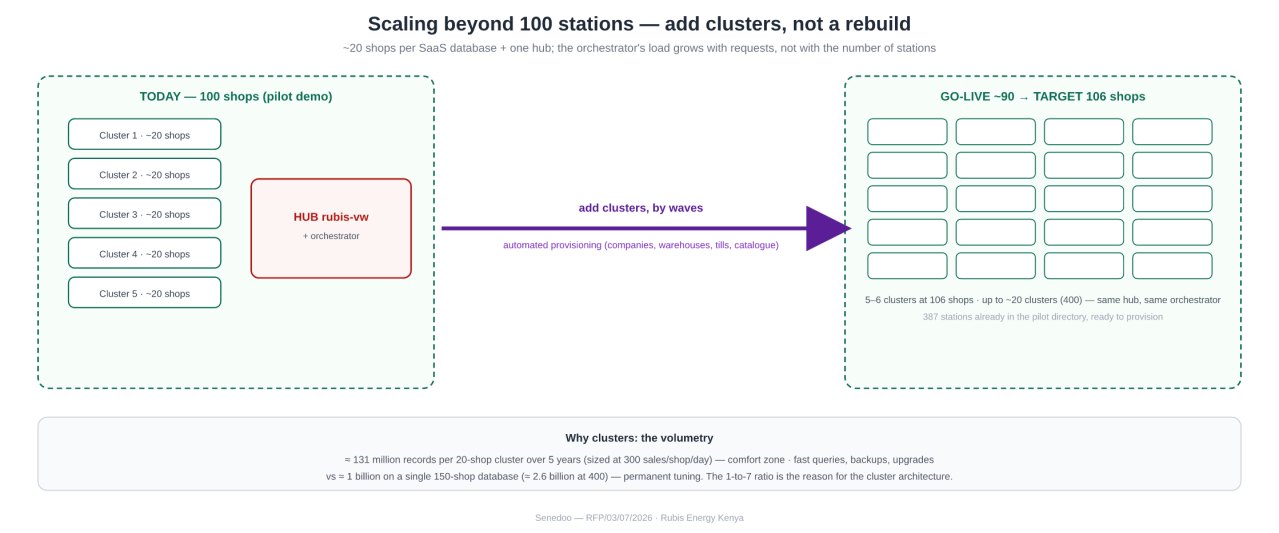
Your Odoo databases, operated by AI — under control.
We developed our own MCP server — Model Context Protocol, the open standard created in late 2024 and adopted by Claude, ChatGPT, Gemini and Copilot, which lets an AI use tools. Ours has three hundred and thirty-seven, all connected to your Odoo databases: diagnostics, Sage import, payroll, reports, tills, backups, dashboards, configuration. No dependency on a single AI vendor.
What took a consultant a day takes ten minutes of conversation. "Check the balance after the import", "install the Commerce agreement on this database and compute a test payroll", "which till is stuck at Racecourse?" — and the answer comes back, with the numbers.
Control stays human. Every write is simulated first, executed only on confirmation, and logged so it can be undone. The AI proposes; the consultant decides.
The SaaS cluster technology
For a shop network or a group of companies, we don't put everything in one database. We spread sites across clusters of about twenty Odoo SaaS databases, linked by our orchestrator: each cluster stays light, an outage never stops the whole network, and you grow by adding a cluster, not by rebuilding.
Resilience
A maintenance window or an incident affects only one cluster of twenty shops: the rest of the network and the hub keep selling and ordering.
Controlled volumes
One till ticket creates twelve records. Over five years a twenty-shop cluster weighs 131 million rows — Odoo's comfort zone. A single 150-shop database would weigh a billion.
Parallelism
POS load is distributed; the orchestrator processes each cluster's flows in parallel. Latency stays stable at peak hours.
Roll-out in waves
One cluster = one wave. Our tooling provisions a complete database — companies, warehouses, tills, catalogue — in an automated, repeatable way.
Master data propagated
A product added at the hub propagates to every cluster and to e-commerce; a permanent consistency check flags any discrepancy — price, code, unit, tax.
One federated view
The dashboard and the MCP tools read clusters one by one or in a cached federated view: to the user, the network reads like a single database.
SaaS, Odoo.sh or on-premise? Why do we prefer Odoo SaaS?
Odoo deploys three ways: Odoo SaaS (odoo.com, hosted and operated by the publisher), Odoo.sh (the publisher's cloud platform with your own Python modules), or on-premise (your servers). We recommend SaaS to almost all our clients, and we prefer to say so with its limits.
| Criterion | ✔ Odoo SaaS (our recommendation) | Odoo.sh | On-premise |
|---|---|---|---|
| Hosting and operations | Included Included in the Enterprise subscription: ISO 27001 infrastructure, replicated backups, monitoring, Odoo S.A.'s availability guarantee. Zero servers to buy or administer. | To plan Hosting billed on top (workers, storage, staging environments). Operations shared between publisher and integrator. | On you Servers, redundancy, backups, security and an operations team at your expense. In Senegal or Kenya, power and connectivity add to the risk. |
| Version upgrades | Included Automatic and continuous, year after year: your databases stay on the latest version with no migration project. | To plan A migration to plan every two or three years, adapting your modules: a project each time. | On you Migration at your expense, often postponed: on-premise databases age, technical debt piles up. |
| Customisation | Included Studio (fields, views, reports, automations) and our technology alongside Odoo (ToolBox, orchestrator, installable add-ons). Honest limit: no way to touch Odoo's source code. Our answer: customisations run on a VPS kept in sync with your database through webhooks and crons, without touching the SaaS database — it stays standard, hence always up to date. | To plan Custom Python modules possible — that is its point, and its trap. A module touches Odoo's source code: at every version it must be reviewed, adapted and retested; until then the upgrade is blocked. A bug in the module stops the whole database, not just the feature. And the code ties you to its author: without them, nobody maintains it. | On you Everything is possible, everything is yours to maintain. Same drawbacks as Odoo.sh Python modules — modified source code, postponed migrations, dependence on the developer — without the platform's automated staging and deployment. This is how databases end up stuck on version 12 or 14. |
| Resilience and scale | Included One database per cluster of about twenty sites; an incident stays local; you grow by adding clusters. | To plan A single database: single point of failure, volumes growing without limit. | On you Same, plus the fragility of your own infrastructure. |
| Total cost | Included The lowest: licences only, no server, no migration, no operations team. | To plan Licences + hosting + periodic migrations. | On you Licences + hardware + team + migrations. The visible cost is low, the real cost is the highest. |
| Data location | Included Odoo data centres (Europe by default). To be examined if a regulation imposes national localisation. | To plan Same (publisher's cloud). | On you At your premises — the one decisive argument for on-premise, when the law requires it. |
| When to choose it | Included SMEs, multi-company groups, shop or station networks, any client who wants an up-to-date system without a technical team. | To plan When a custom business module is genuinely indispensable and you accept paying for its maintenance. | On you Legal data-localisation obligation, or a site without reliable internet with an on-site IT team. |
Our position. What a client asks for "bespoke" is almost always solved by Studio, by an installable Senedoo add-on, or by our technology working alongside Odoo in real time — without ever leaving SaaS. When it isn't, we say so, and we support you on Odoo.sh. We have never yet had to recommend on-premise.
The Senedoo ToolBox
Your client portal
senedoo-toolbox.com: single sign-on to all your databases, financial reports, Excel exports, dashboards, project tracking, video tutorials.
Add-ons inside Odoo
Twenty-nine installable tools — OHADA reports, returns, payroll, shelf tags, mobile money — updated centrally, with no intervention on your side.
The MCP server
Connector for Claude and ChatGPT, reserved for our consultants and, on request, your trained teams. Dry-run by default, undo log.